Einstein tiling
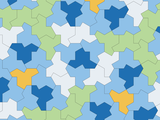
The "hat" is a single shape that tiles the plane aperiodically (without translational symmetry). This post introduces the Python package einstein-tiling, which can be used to build these tilings.
24 posts on art. All posts · RSS feed
The "hat" is a single shape that tiles the plane aperiodically (without translational symmetry). This post introduces the Python package einstein-tiling, which can be used to build these tilings.
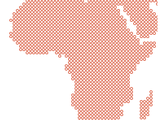
A Python script to generate stylised maps with land regions depicted by spaced markers (circles, polygons, etc).
Inspired by David Richeson's applet on GeoGebra the Python script below plots the lines joining pairs of points, evenly spaced on the perimeter of a circle according to the following algorithm: label the points ; then join point to point . The line segments inside …
A Maurer rose is a shape formed by connecting the points on a rose defined in the polar coordinate system by for some positive integer, . The points to join are, in polar coordinates using degrees: For example, the Maurer rose defined by is: The …
Just a quick script to approximate a given target image from a large number of overlapping straight lines. The algorithm is rather inefficient: each line is added to several copies of the the approximation so far, and the best one chosen (ie the one that …
The Cistercian numeral counting system used by the Cistercian monastic order in the late medieval period. The digits 1 – 9 are depicted as symbols arranged around a vertical stave. By placing these symbols reflected vertically and/or horizontally into each of four locations the decimal …
This is an update to the post from February 2016 with an improved algorithm (given below) for generating pleasing random images by sequentially shifting the colour of pixels across a canvas. By using scipy.ndimage.convolve1d, one explicit Python loop can be dispensed with, speeding it up. …
Just a quick experiment in creating animated surfaces in Matplotlib. The distortions to the plane are sine waves applied in octaves with a random phase, : where is the amplitude (decreasing with increasing frequency) and is the frequency of the th wave. The animation is …
Following on from this earlier post, here is a class, TruchetHexes, which generates a pleasing weave-like pattern by tiling the following hexagon shapes in random orientations. A typical image looks like this: This code requires the truchet.py file from this previous post on Truchet tiles.