Skip to content
scipython.com

E6.13Creating a rotation matrix in NumPy

The two dimensional rotation matrix which rotates points in the \(xy\) plane anti-clockwise through an angle \(\theta\) about the origin is

\[\mathbf{R} = \left(\begin{array}{rr}\cos\theta & -\sin\theta\\ \sin\theta & \cos\theta \end{array}\right).\]

To create a rotation matrix as a NumPy array for \(\theta=30^\circ\), it is simplest to initialize it with as follows:

In [x]: theta = np.radians(30)
In [x]: c, s = np.cos(theta), np.sin(theta)
In [x]: R = np.array(((c, -s), (s, c)))
Out[x]: print(R) 
[[ 0.8660254 -0.5      ]
 [ 0.5        0.8660254]]

As of NumPy version 2.2 there is still a matrix subclass, which offers a Matlab-like syntax for manipulating matrices, but its use is no longer encouraged and (with luck) it will be removed in future.


Derivation 1

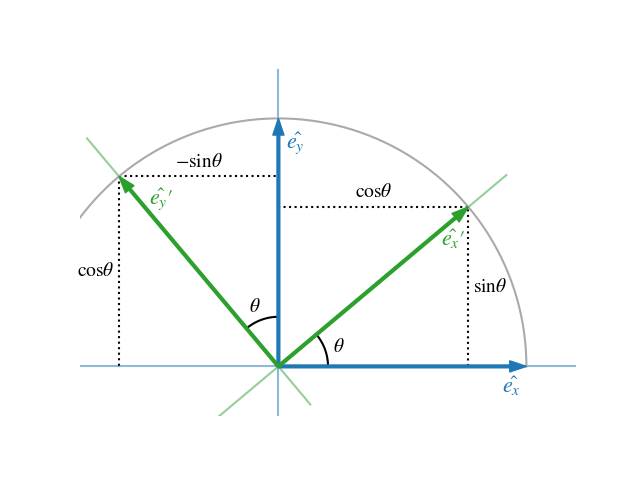
Since rotations are linear transformations, the effect of rotating a vector from the origin to some arbitrary point, \(P = (x, y)\), can be established by considering the rotation of the basis vectors \(\hat{\boldsymbol{e}}_x \equiv (1,0)\) and \(\hat{\boldsymbol{e}}_y \equiv (0,1)\). In the figure below, a rotation by \(\theta\) takes

\[\begin{align*} \hat{\boldsymbol{e}}_x &\rightarrow \hat{\boldsymbol{e}}_x' = \cos\theta\hat{\boldsymbol{e}}_x + \sin\theta\hat{\boldsymbol{e}}_y, \\ \hat{\boldsymbol{e}}_y &\rightarrow \hat{\boldsymbol{e}}_y' = -\sin\theta\hat{\boldsymbol{e}}_x + \cos\theta\hat{\boldsymbol{e}}_y. \end{align*}\]

Our point \(P\) is therefore transformed from \((x, y) \equiv x\hat{\boldsymbol{e}}_x + y \hat{\boldsymbol{e}}_y\) to:

\[\begin{align*} P' = x\hat{\boldsymbol{e}}_x' + y \hat{\boldsymbol{e}}_y' = (x\cos\theta - y\sin\theta)\hat{\boldsymbol{e}}_x + (x\sin\theta + y\sin\theta)\hat{\boldsymbol{e}}_y. \end{align*}\]

That is,

\[\begin{align*} P' = \mathbf{R}P = \left(\begin{array}{rr}\cos\theta & -\sin\theta\\ \sin\theta & \cos\theta \end{array}\right)\left(\begin{array}{r}x \\ y \end{array}\right). \end{align*}\]
Rotation of a coordinate system in 2D

Derivation 2

Consider the point \(P\) in polar coordinates: \(P = (x, y) = (r\cos\phi, r\sin\phi)\). Rotation by an angle \(\theta\) takes

\[\begin{align*} P \rightarrow P' &= (r\cos(\phi+\theta), r\sin(\phi+\theta)) \\ &= (r[\cos\phi\cos\theta - \sin\phi\sin\theta], r[\cos\phi\sin\theta + \sin\phi\cos\theta])\\ &= (x\cos\theta - y\sin\theta, x\sin\theta + y\cos\theta)\\ &= \left(\begin{array}{rr}\cos\theta & -\sin\theta\\ \sin\theta & \cos\theta \end{array}\right)\left(\begin{array}{r}x \\ y \end{array}\right). \end{align*}\]