
The molecular kinetic energy operator for a diatomic molecule may be written
where \(\mathbf{P}_{\alpha} = -i\hbar \nabla_{\alpha}\) and \(\mathbf{P}_i = -i\hbar \nabla_i\) are the momentum operators for the two nuclei and \(n\) electrons, respectively. \(M_\alpha\) are the masses of the nuclei and \(m\) is the electron mass. The vector differential operator del is
\(\mathbf{e}_X\), \(\mathbf{e}_Y\) and \(\mathbf{e}_Z\) being the unit vectors along the \(X\), \(Y\) and \(Z\) axes such that the position of the \(i\)th electron is \(\mathbf{R}_i = X_i\mathbf{e}_X + Y_i\mathbf{e}_Y + Z_i\mathbf{e}_Z\) (and similarly for the nuclei).
Transformation from a space-fixed axis system with an arbitrary origin to one with the origin at the centre of mass of the molecule allows the translational motion of the whole molecule to be separated from its internal motion (rigorously, in the case of field-free space). The new axes remain parallel to the space-fixed axes: the transformation moves the origin but does not rotate the axes.
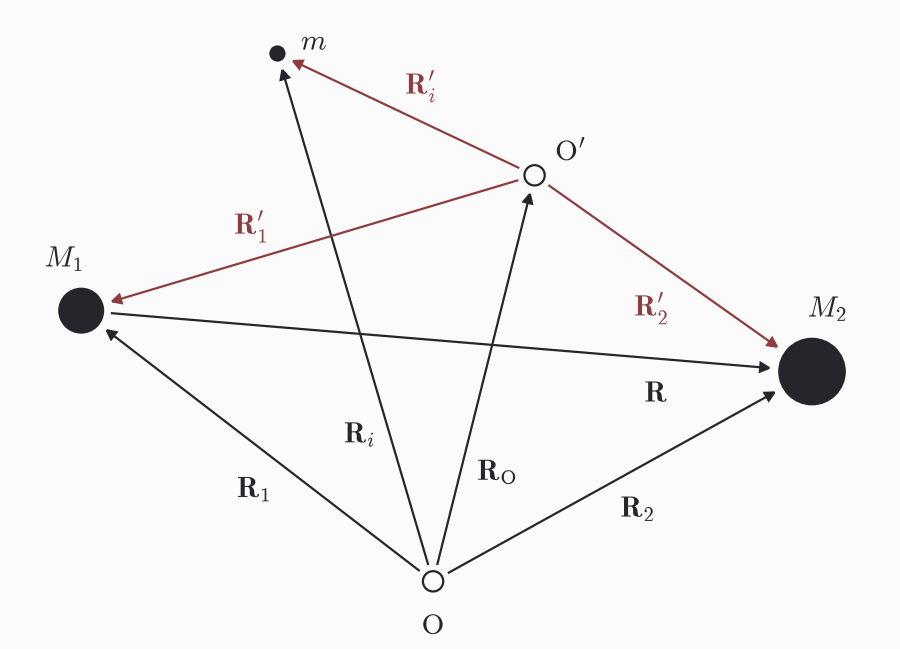
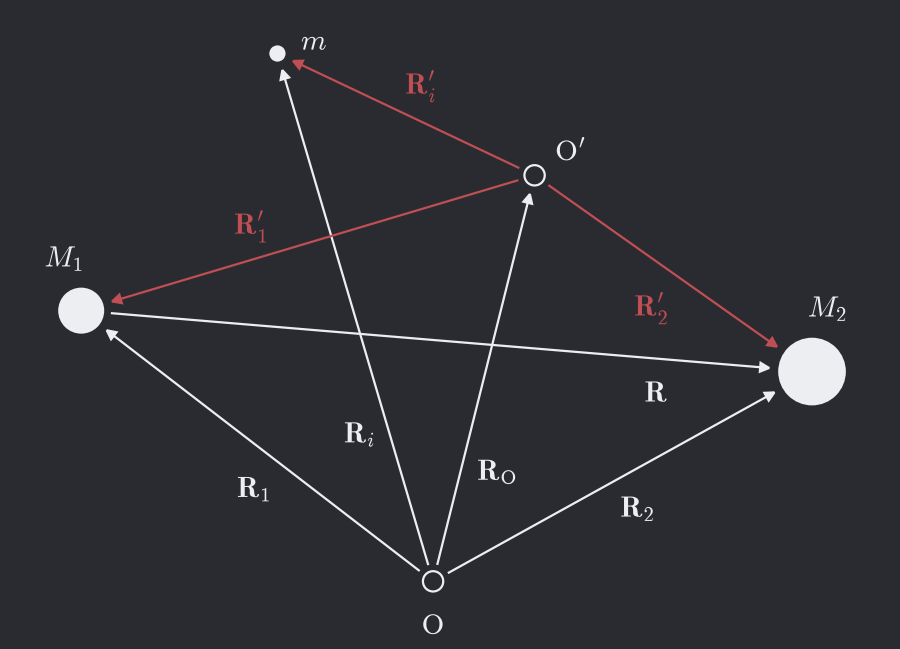
In these new coordinates the position vectors of the electrons and nuclei are:
where
is the position of the molecular centre of mass (O′ in the figure) in the original coordinate system and
is the total mass of the molecule (electrons and nuclei). The position vectors \(\mathbf{R}'_i\) and \(\mathbf{R}'_\alpha\) represent \(3n+6\) coordinates referred to the centre of mass plus an additional three centre of mass coordinates (\(\mathbf{R}_\mathrm{O}\)). Therefore, three of these spatial coordinates are redundant, since the relation
can readily be shown to hold from the definitions of \(\mathbf{R}'_i\) and \(\mathbf{R}'_\alpha\). We can remove this redundancy by considering the internuclear vector \(\mathbf{R} = \mathbf{R}'_2 - \mathbf{R}'_1 = \mathbf{R}_2 - \mathbf{R}_1\) instead of the vectors \(\mathbf{R}'_1\) and \(\mathbf{R}'_2\) separately.
The transformation to molecular centre-of-mass coordinates therefore involves a change from the set of coordinates \(\mathbf{R}_i\) and \(\mathbf{R}_\alpha\) to the new set of coordinates \(\mathbf{R}'_i\), \(\mathbf{R}_\mathrm{O}\) and \(\mathbf{R}\). Correspondingly, the kinetic energy operator must be rewritten in terms of the momenta conjugate to these coordinates: respectively, \(\mathbf{P}'_i = -i\hbar\nabla'_i\), \(\mathbf{P}_\mathrm{O} = -i\hbar\nabla_\mathrm{O}\) and \(\mathbf{P}_R = -i\hbar\nabla_R\). Each of these del operators differentiates with respect to one of the new coordinates with the others held fixed, which is why \(\mathbf{P}'_i\) differs from \(\mathbf{P}_i\). In its original form, the kinetic energy operator was written in terms of \(P_i^2\) and \(P_\alpha^2\). Each new position vector is a linear combination of the old ones with scalar coefficients, so the same coefficient applies to the \(X\), \(Y\) and \(Z\) components and, from the chain rule,
where \(X_\mathrm{O}\), \(X\) and \(X'_j\) are the \(X\) components of \(\mathbf{R}_\mathrm{O}\), \(\mathbf{R}\) and \(\mathbf{R}'_j\). Now, from the above definitions,
Therefore,
and, since the coefficients are constants and derivatives with respect to different coordinates commute, the square of \(\mathbf{P}_i\) expands as it would for ordinary vectors:
Similarly, for the nuclear momenta:
where
Therefore,
Similarly,
Summing these formulas gives the transformed form of the kinetic energy operator:
where \(\mu = M_1M_2 / (M_1 + M_2)\) is known as the reduced mass of the nuclei.
Show derivationHide derivation
Collecting together like terms in the sum gives:
where we have used the identity
Further simplification is achieved using the relation
and the definition \(M=M_1 + M_2 + nm\) to give the above equation for \(T\).
The four terms in this equation are, respectively: the translational kinetic energy of the molecule as a whole, the relative kinetic energy of the nuclei (rotational and vibrational), the kinetic energy of the electrons relative to the centre of mass, and a term known as the mass polarization term. This last term couples the momenta of different electrons: it arises because the electron coordinates are measured from the centre of mass, which moves whenever any electron moves. Its coefficient is smaller than that of the electronic kinetic energy by a factor of \(m/M\). Since the double sum includes the terms with \(i = j\), it also reduces the coefficient of each \(P_i'^2\) from \(1/(2m)\) to \(1/(2m) - 1/(2M)\); the name mass polarization term is often given only to the remaining terms, with \(i \ne j\).
In the absence of externally applied fields, space is homogeneous: the potential energy depends only on the relative positions of the particles, and so not on \(\mathbf{R}_\mathrm{O}\), and the kinetic energy operator above has no terms coupling \(\mathbf{P}_\mathrm{O}\) to the other momenta. In this case, the wavefunction can be rigorously factorized into a part describing the translational motion of the molecule as a whole and a part describing everything else. Correspondingly, we will drop the first term in the kinetic energy operator to focus on the internal motions of the molecule. The following post transforms the operator further, to an origin at the centre of mass of the nuclei.