
A previous post derived the form of the kinetic energy operator for a diatomic molecule with the origin at the molecular centre of mass and axes parallel to the space-fixed axes:
where \(\mu = M_1M_2 / (M_1 + M_2)\) is the reduced mass of the nuclei, \(m\) is the electron mass, \(M = M_1 + M_2 + nm\) is the total molecular mass (including the \(n\) electrons), and \(\mathbf{P}_\mathrm{O}\), \(\mathbf{P}_R\) and \(\mathbf{P}'_i\) are the momenta conjugate to the coordinates of the molecular centre of mass, the internuclear vector and the electrons, respectively.
We now want to transform the coordinate system further so that its origin lies at the centre of mass of the nuclei, located at:
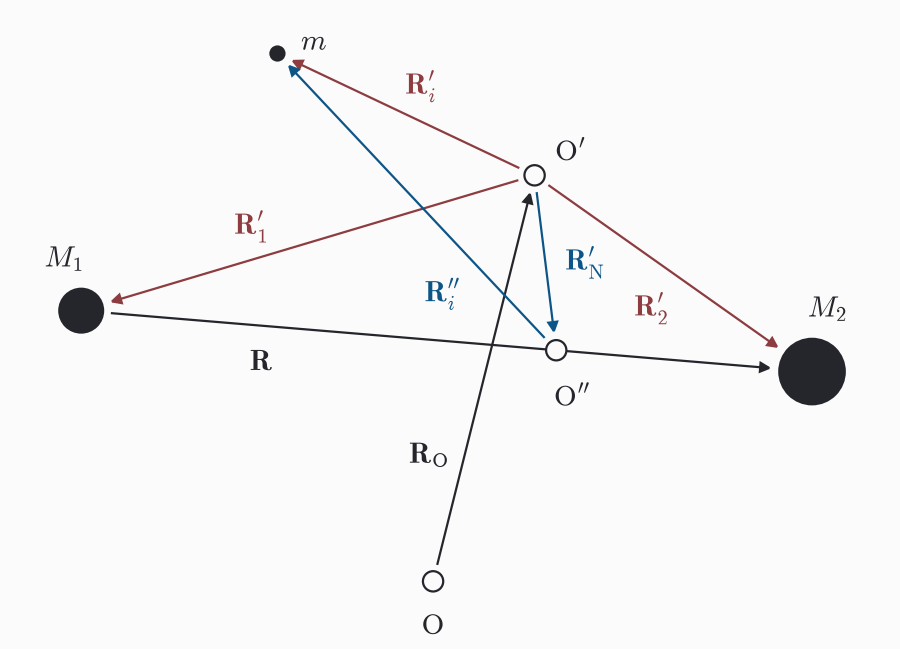
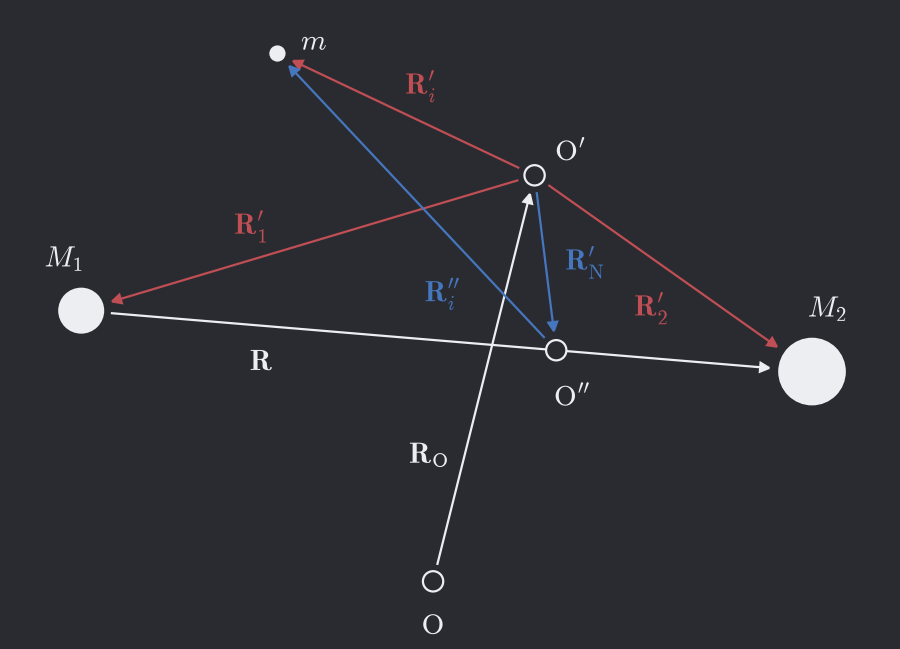
In this new coordinate system, the electrons and nuclei have position vectors \(\mathbf{R}''_i = \mathbf{R}'_i - \mathbf{R}'_\mathrm{N}\) and \(\mathbf{R}''_\alpha = \mathbf{R}'_\alpha - \mathbf{R}'_\mathrm{N}\). The nuclei are therefore at
positions that depend only on the internuclear vector, \(\mathbf{R} = \mathbf{R}'_2 - \mathbf{R}'_1\). This is the reason for the transformation: the potential energy then depends only on \(\mathbf{R}\) and the electron positions \(\mathbf{R}''_i\), whereas with the origin at the molecular centre of mass the nuclear positions \(\mathbf{R}'_\alpha\) also depend on the coordinates of every electron, through \(\mathbf{R}'_\mathrm{N}\).
From the definition of the molecular centre of mass,
it follows that
The new coordinates are therefore \(\mathbf{R}_\mathrm{O}\), \(\mathbf{R}\) and \(\mathbf{R}''_i\). Our goal is to transform the kinetic energy operator above into a form involving the electron momenta in this new coordinate system, \(\mathbf{P}''_i = -i\hbar\nabla''_i\), where \(\nabla''_i\) differentiates with respect to \(\mathbf{R}''_i\) with \(\mathbf{R}_\mathrm{O}\), \(\mathbf{R}\) and the other \(\mathbf{R}''_j\) held fixed. Since \(\mathbf{R}_\mathrm{O}\) and \(\mathbf{R}\) are unchanged and the \(\mathbf{R}''_i\) depend only on the \(\mathbf{R}'_j\), the momenta \(\mathbf{P}_\mathrm{O}\) and \(\mathbf{P}_R\) are unchanged by the transformation. As in the previous post, the same coefficient applies to the \(X\), \(Y\) and \(Z\) components and, from the chain rule,
where \(X'_i\) and \(X''_j\) are the \(X\) components of \(\mathbf{R}'_i\) and \(\mathbf{R}''_j\), and
Therefore,
and
Substituting these two equations into that for \(T\) above gives:
Show derivationHide derivation
Collecting terms after the substitution gives
Since \(M = M_1 + M_2 + nm\), the coefficient in square brackets simplifies to
The first two terms are unchanged by the transformation. Separating the terms with \(i = j\) from those with \(i \ne j\) in the double sum gives
where
is the reduced mass of an electron and a particle of mass \(M_1 + M_2\) (the two nuclei together), since \(1/\mu_\mathrm{e} = 1/m + 1/(M_1 + M_2)\). The last term is the mass polarization term in these coordinates: it couples the momenta of different electrons, and its coefficient, \(1/(2(M_1 + M_2))\), is smaller than \(1/(2m)\) by a factor of \(m/(M_1 + M_2)\). It is positive, whereas with the origin at the molecular centre of mass the coefficient of the mass polarization term was \(-1/(2M)\).