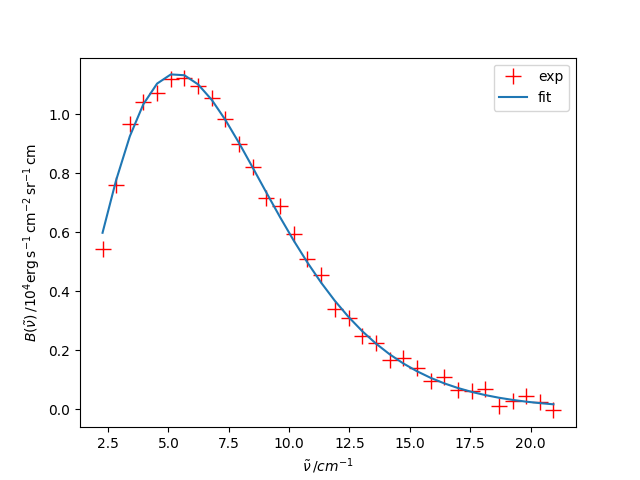
P8.X.1Fitting the Cosmic Microwave Background
The NASA Cosmic Background Explorer (COBE) satellite carried an instrument, FIRAS (Far-Infrared Absolute Spectrophotometer) to measure the cosmic microwave background (CMB) radiation, which was confirmed to be distributed according to a black-body curve in accordance with the big bang theory:
where the radiation frequency is expressed in wavenumbers, \(\mathrm{cm^{-1}}\), and the speed of light, \(c\), is taken to be in \(\mathrm{cm\,s^{-1}}\).
The data file cmb-data.txt contains measurements of \(I(\tilde{\nu})\) based on the FIRAS observations. Note that the units of \(I\) in this file are \(\mathrm{erg\,s^{-1}\,cm^{-2}\,sr^{-1}\,cm}\) and that \(1\;\mathrm{J}\equiv 10^7\;\mathrm{erg}\). Use scipy.optimize.curve_fit to determine the temperature of the CMB and take the estimated \(1\sigma\) error in the measurement to be \(2 \times 10^{-6}\;\mathrm{erg\,s^{-1}\,cm^{-2}\,sr^{-1}\,cm}\).
Show solution
The following code fits the provided CMB data to give a temperature of \(2.715 \pm 0.004\;\mathrm{K}\).
import matplotlib.pyplot as plt
import numpy as np
from scipy.constants import h, c, k

c = 100 * c
from scipy.optimize import curve_fit

nu, cmb = np.loadtxt("cmb-data.txt", unpack=True)


def B(nu, T):
    return 2 * h * nu**3 * c**2 / (np.exp(h * c * nu / k / T) - 1) * 1.0e7


sigma = 2.0e-6

T0 = 1
popt, pcov = curve_fit(B, nu, cmb, p0=(T0,), sigma=sigma, absolute_sigma=True)
Tfit = popt[0]
Bfit = B(nu, Tfit)

perr = np.sqrt(np.diag(pcov))[0]
print("Tcmb = {:.3f} ± {:.3f} K".format(Tfit, perr))

plt.plot(nu, cmb * 1.0e4, "+r", markersize=12, label="exp")
plt.plot(nu, Bfit * 1.0e4, label="fit")
plt.ylabel(
    r"$B(\tilde{\nu})\,/10^4\mathrm{erg\,s^{-1}\,cm^{-2}\,sr^{-1}\,cm}$"
)
plt.xlabel(r"$\tilde{\nu}\,/cm^{-1}$")
plt.legend()
plt.show()
Output:
Tcmb = 2.715 ± 0.004 K