
P10.2.1Numerical differentiation
The simplest (and least accurate) way to calculate the first derivative of a function is to simply use the definition:
\[f'(x) = \lim_{h\rightarrow 0} \frac{f(x+h) - f(x)}{h},\]
fixing \(h\) at some small value, our approximation is
\[f'(x) \approx \frac{f(x+h) - f(x)}{h},\]
Using the function \(f(x) = e^x\), which value of \(h\) (to the nearest power of 10) gives the most accurate approximation to \(f'(1) = e\)?
Show solution
First define a function to return the derivative of \(f(x)\) using a provided value for \(h\):
In [x]: def calc_deriv(x, f, h):
   ...:     return (f(x+h) - f(x)) / h
and use it to approximate the derivative of \(f(x)=e^x\) at \(x=1\) for \(h\) between \(10^{-17}\) and \(0.1\) on a logarithmic scale:
In [x]: h = np.logspace(-17,-1,17)
In [x]: derivs = calc_deriv(1, np.exp, h)
We're interested in the differences between these approximations and the true answer, \(f'(1) = e\). On a log scale,
In [x]: errors = np.abs(derivs - np.e)
In [x]: plt.loglog(h, errors, base=10)
In [x]: plt.xlabel("$h$")
In [x]: plt.ylabel("error")
In [x]: plt.show()
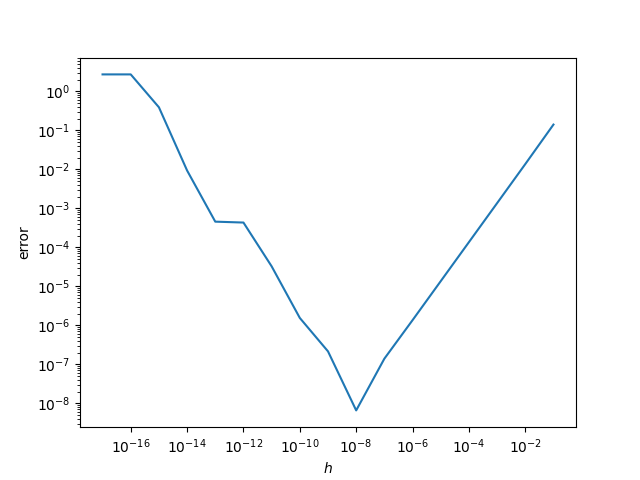
The optimum, \(h\), balancing truncation and cancellation errors, is about \(10^{-8}\).