
The equation of the circle containing three (non-colinear) points can be found using the following procedure.
Let the three points be \(A: (a, b)\), \(B: (c, d)\) and \(C: (x_0, y_0)\). The equation of a circle with diameter \(\overline{AB}\) is:
and the equation of the line through \(\overline{AB}\) is
It can be shown that that there exists a number \(\alpha\) such that \(f(x,y) = \alpha g(x,y)\) is the equation of the circle through \(A\), \(B\) and \(C\). By direct substitution of the coordinates of \(C\), the value of \(\alpha\) is:
Substituting the above expressions for \(f(x,y)\) and \(g(x,y)\) and completing the square leads to the following convenient form for the equation of the circle:
That is, the circle is centered on
and has radius
The code below demonstrates the use of this formula for the points \((-3, -1)\), \((-4, 3)\) and \((1, 2)\).
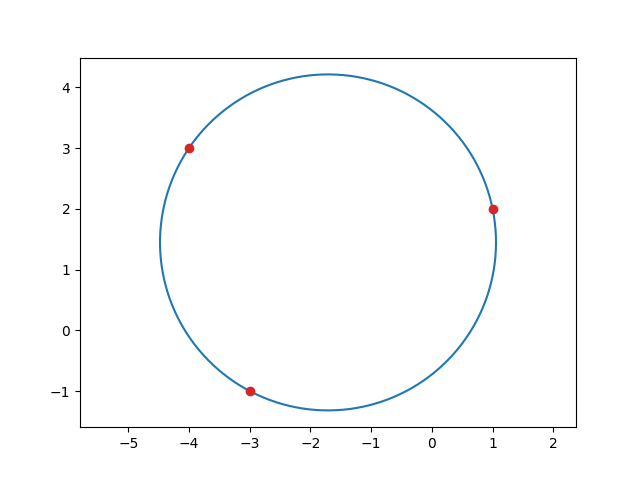
import numpy as np
import matplotlib.pyplot as plt

A, B, C = (-3, -1), (-4, 3), (1, 2)

a, b = A
c, d = B
x0, y0 = C

alpha = ((x0-a)*(x0-c) + (y0-b)*(y0-d)) / ((b-d)*x0 - (a-c)*y0 + a*d - b*c)

xc = ((a+c) + alpha*(b-d)) / 2
yc = ((b+d) - alpha*(a-c)) / 2
r2 = alpha * (a*d - b*c) - a*c - b*d + xc**2 + yc**2
r = np.sqrt(r2)

th = np.arange(0, 2*np.pi, 0.01)
x, y = r * np.cos(th) + xc, r * np.sin(th) + yc

plt.plot(x, y)
plt.scatter(*np.array((A, B, C)).T, c='tab:red', zorder=2)
plt.gca().axis('equal')
plt.show()