
Circuit symbols
In a circuit diagram, wires are drawn as straight lines. A dot marks where wires are joined; wires that cross without a dot are not joined. These are the symbols of Pearson's (Edexcel) specification and WJEC's; AQA's are among them.
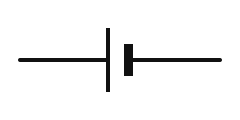 cell |
The longer line is the positive terminal. |
|---|---|
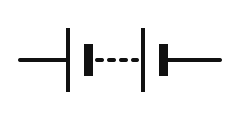 battery |
Two or more cells joined together. The dashed line means that there can be more cells in between; it is sometimes drawn as a solid line. |
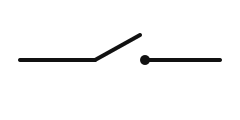 open switch |
The circuit is broken, so no current flows. |
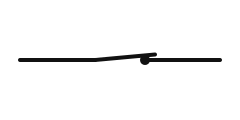 closed switch |
The circuit is complete, so current can flow. |
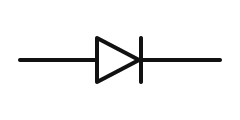 diode |
Lets current flow one way only, in the direction the triangle points. |
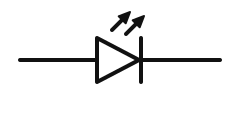 light-emitting diode |
A diode that gives out light when a current flows through it. It is sometimes drawn inside a circle. |
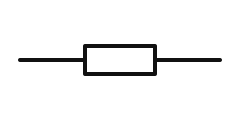 resistor |
Limits the current in a circuit. |
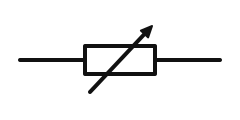 variable resistor |
A resistor whose resistance can be changed, such as to dim a lamp. |
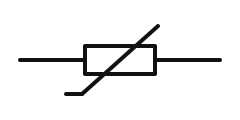 thermistor |
A resistor whose resistance changes with temperature: for the usual kind, it falls as the thermistor gets hotter. |
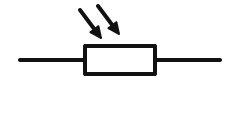 light-dependent resistor |
A resistor whose resistance falls as the light on it gets brighter. It is sometimes drawn inside a circle. |
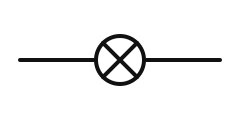 lamp |
Gives out light when a current flows through it. |
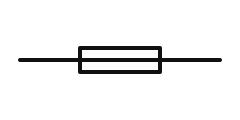 fuse |
Melts, breaking the circuit, if the current becomes too large. A circuit breaker, which does the same job but can be reset, has the same symbol. |
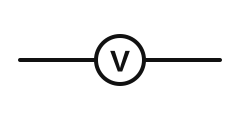 voltmeter |
Measures the potential difference (voltage) across a component, so it is connected in parallel with it. |
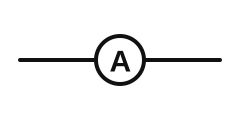 ammeter |
Measures the current, so it is connected in series. |
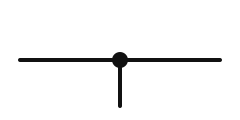 junction |
The dot shows that the wires are joined. |
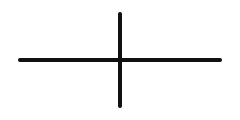 wires crossing with no connection |
Wires that cross without a dot are not joined. |
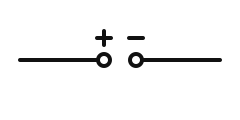 d.c. power supply |
A supply of direct current, which flows one way only, out of the positive (+) terminal and round the circuit to the negative (−) one. |
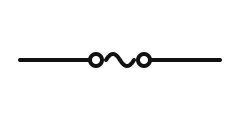 a.c. power supply |
A supply of alternating current, which changes direction many times a second (50 times a second for the mains in the UK). |
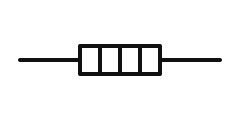 heater |
Transfers energy to its surroundings by heating them. |
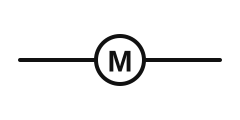 motor |
Turns when a current flows through it. |
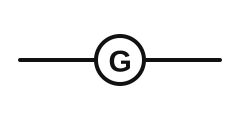 generator |
Produces a potential difference (voltage) when it is turned. |
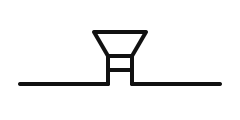 loudspeaker |
Turns electrical signals into sound. |
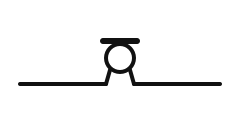 microphone |
Turns sound into electrical signals. |
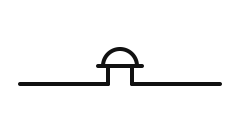 electric bell |
Rings when a current flows through it. |
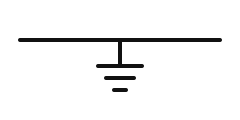 earth |
A connection to the ground, which keeps a metal case safe to touch if a fault makes it live. |
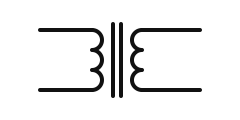 transformer |
Two coils wound on an iron core. It changes the size of an alternating potential difference (voltage): up, in a step-up transformer, or down, in a step-down one. |